
 Dieser Song ist einer der größten Single-Hits von Kate Bush und bis heute hat er nichts von seiner Faszination und seiner Wucht verloren. „Zu monumental für jede denkbare Kategorisierung“ – diesen Satz schrieb Ulf Kubanke [1] in einer Review zum Album „Hounds of Love“ und dies trifft ganz besonders auf diesen „Überhit“ [1] „Running up that Hill“ zu (unter Insidern unter dem Kürzel RUTH bekannt).
 Er entstand im Sommer 1983 als erster Song des Albums [2] – ein hymnisch vorantreibender Titel voller Energie mit einem Grundteppich aus leisen Trommeln und einem orgelpunktartig eingesetzten Synthesizerakkord. Der Song handelt von der Unmöglichkeit, dass sich zwei Liebende wirklich verstehen können und wie verlockend es wäre, für eine kurze Zeit die Körper tauschen zu können und in die Seele des Gegenüber einzutauchen. Er ist energisch und perfekt gesungen – offenbar handelt es sich um eine sehr energiegeladene Beziehung, in der die Funken fliegen. Es ist bei jedem Wiederhören zu spüren: „Running up that hill“ ist besonders, ungewöhnlich. Hinter dem Kleid einer Hitsingle versteckt sich etwas Tiefergehendes. Ulf Urbanke fasst das sehr gut zusammen [1]: „Der Überhit „Running Up That Hill“ wartet mit einer der prägnantesten Synthie-Hooks aller Zeiten auf. Für diesen Deal mit Gott packt sie etwas Forderndes, nahezu Eiferndes in den Gesang. Das verleiht dem Song eine Intensität, die fast allen Pophits ganz und gar fehlt.“
„I am very excited about how it’s been received by people! It’s so rewarding after working for a long time to see that your work is being received with open arms. This song is very much about two people who are in love, and how the power of love is almost too big for them. It leaves them very insecure and in fear of losing each other. It’s also perhaps talking about some fundamental differences between men and women.“ [3]
„I was trying to say that, really, a man and a woman, can’t understand each other because we are a man and a woman. And if we could actually swap each others roles, if we could actually be in each others place for a while, I think we’d both be very surprised! [Laughs] And I think it would be lead to a greater understanding. And really the only way I could think it could be done was either… you know, I thought a deal with the devil, you know. And I thought, „well, no, why not a deal with God!“ You know, because in a way it’s so much more powerful the whole idea of asking God to make a deal with you.“ [4]
„You see, for me it is still called „Deal With God“, that was it’s title. But we were told that if we kept this title that it wouldn’t be played in any of the religious countries, Italy wouldn’t play it, France wouldn’t play it, and Australia wouldn’t play it! Ireland wouldn’t play it, and that generally we might get it blacked purely because it had „God“ in the title. Now, I couldn’t believe this, this seemed completely ridiculous to me and the title was such a part of the song’s entity. I just couldn’t understand it. But none the less, although I was very unhappy about it, I felt unless I compromised that I was going to be cutting my own throat, you know, I’d just spent two, three years making an album and we weren’t gonna get this record played on the radio, if I was stubborn. So I felt I had to be grown up about this, so we changed it to „Running Up That Hill“. But it’s always something I’ve regretted doing, I must say. And normally I always regret any compromises that I make.“ [4]
 Bei diesem Problem musste also selbst eine Frau mit einem so eisernen Willen wie Kate Bush einem Kompromiss zustimmen. Man kann in jedem ihrer Worte spüren, wie wenig ihr das gefällt. So kam der Song also zu seinem Titel „Running up that hill“ und „A deal with god“ taucht nur noch als Untertitel auf. Für mich passt der neue Titel aber auch sehr gut, weil er die Grundstimmung des Songs wiedergibt: „It’s meant to be the positivism of going somewhere. Climbing up a mountain, going up. It might be hard but you are getting there.“ [5]
„I think everyone at some times feels misunderstood. But I can’t think of any song that I would say was truly autobiographical. There’s something of me in every song, in that I’m expressing something I’m hoping is interesting. But I don’t think they’re truly autobiographical comments in any way.“ [6]
„I had an idea of what I wanted to say in the song and I actually asked Del to write me a drum pattern, and he wrote this great pattern in the drum machine. So I just put the Fairlight on top of it and that was the basis of the song, with the drum, which played quite an important part. “ [4]
Hält man sich an die Tonartencharakteristiken von Hermann Beckh [8], so sieht man, dass hier ganz weit auseinanderliegende Gefühlwelten miteinander verbunden werden. Die Protagonistin ist in ihren Gefühlen hin und her gezogen. Es-Dur und c-Moll haben einen starken, positiven, kämpferischen Charakter. C-Moll steht von allen Tonarten am festesten auf der Erde, es steht für eigene Kraft und Stärke, für Verwurzelung auf dem Boden, aber auch für die Tragik des Irdischen. Es ist die Haupttonart des Songs und drückt klar dessen kämpferischen Charakter und die Stärke der Protagonistin aus. Wie später in „The Fog“ und „Lily“ wird diese Tonart auch hier im Zusammenhang mit einer Anrufung der positiven Mächte benutzt. Es-Dur ist die Tonart der Feier, die geistige Sonne scheint hier am hellsten. „Das Schauen der Sonne um Mitternacht“ nennt das Beckh.
B-Bur ist halbdunkel, helldunkel, es ist eine Liebestonart, steht aber auch für feste Glaubenszuversicht. Bezeichnenderweise erklingt der B-Dur-Akkord immer zum Wort „God“ [7]. G-Moll ist im Gegensatz dazu klagend, mehr tragisch; es fehlt die Ahnung und Hoffnung auf Licht, die B-Dur erahnen lässt.
In den Akkordfolgen wird die Zerrissenheit der Situation deutlich. Die Folge As-Dur/B-Dur/c-Moll lässt zu Beginn ein Licht in der Finsternis aufleuchten (die Beziehung ist komplex und verworren) und drückt dann die feste Zuversicht in die Liebe aus (es ist verworren, aber sie lieben sich dennoch). Es folgt das Bauen auf die eigene Stärke und das Vertrauen auf die eigene Stärke (die Protagonistin will und wird die Probleme lösen). Kommt dann noch der g-Moll-Akkord als Abschluss dazu, dann verliert sich die Protagonistin dennoch in Zweifeln.
Die Akkordfolge As-Dur/Es-Dur/f-Moll zu „You. It’s you and me wont’t be unhappy“ ist zerrissener. Das aufleuchtende Licht in der Finsternis führt zur Siegeszuversicht, zum Erahnen der Sonne in der dunklen Nacht. Aber es folgt der tiefe Absturz, es ist trotzdem Nacht, die Nacht, in der es keine Erlösung gibt. Die Tonarten dieser Akkordfolge deuten an, dass die Beschwörung der Protagonistin vielleicht doch keinen Erfolg haben wird. Gott antwortet nicht in dieser Musik. Zum Glück endet der Song auf einem lang angehaltenen c-Moll-Akkord. Das Vertrauen in die eigene Stärke siegt (aber vielleicht ist die Beziehung nicht zu retten).
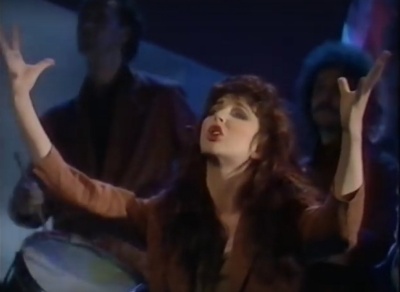
Dieses Ersatzvideo zählt für Kate Bush nicht. Es ist eine „TV performance that we did in England to promote the single. And I don’t do very many TV performances. It concerns me that to try and to do everything you can and put as much effort into it, and sometimes its very difficult to make things look good in TV situations. But that was a live TV and we presented it that way for the British audience. It wasn’t my intention that that clip would be shown anywhere else at all, apart from that one live performance in England. And it was something that the record company wanted to use here, and that’s why you’re seeing that. From my point of view, the expression visually that goes with that song is the film that we made that is the dance video. And the other one is really for me just a one-off TV.“ [6]
 Der Dreh des Videos erforderte intensives Training und eine sorgfältige Vorbereitung. „The video took eight weeks: six weeks‘ training and choreography working with Dyane Gray, and three days shoot, plus editing and various meetings.“ [11] Die surrealen Details kamen dann im Laufe der Vorbereitung hinzu. Die Frage nach dem Ursprung der Masken erläuterte Kate Bush in einem Interview: „Well that was very much a coincidence, where the director was talking about these masks and I had a film on video that we’d taped that had a section where people were wearing these photographic masks. And we just felt that it was a really interesting idea, this crowd that would suddenly sorta rush in through the dance sequence. And the idea of the crowd being the force of either the man or the woman and so the faces change from the man to the woman. And then the idea of drowning in yourself. Just sorta those kinda plays on things. [6]
[2] Graeme Thomson: Graeme Thomson: Kate Bush. Under the ivy. 2013. Bosworth Music GmbH. S.258
[3] Kate Bush: Hounds Of Love songs. KBC article Issue 18.
[4] Richard Skinner: Classic Albums interview: Hounds Of Love. Radio 1. Interview gesendet 26.01.1992.
[5] Phil McNeil: Kate Bush Isn’t Your Everyday Songwrite. Star Parts(?). Datum unbekannt.
[6] J.J. Jackson: Uneditet. MTV. November 1985
[7] “Kate Bush Complete”. EMI Music Publishing / International Music Publications. London. 1987. S.142ff
[8] Hermann Beckh: Die Sprache der Tonart in der Musik von Bach bis Bruckner. Verlag Urachhaus. Stuttgart 1999. S.124-126 (Es-Dur/c-Moll). S.196-198 (As-Dur/f-Moll), S.245-248 (B-Dur/g-Moll)
[9] https://en.wikipedia.org/wiki/Running_Up_That_Hill (gelesen 08.09.2017)
[10] Good Rockin Tonight. Nan Devitt(?). November. 1985
[11] Kate Bush: An Interview With Auntie Hetty. KBC article Issue 20.






Neueste Kommentare